Views: 0 Author: Site Editor Publish Time: 2026-08-14 Origin: Site
Driven by the wave of smart manufacturing, the iteration cycle of factory production lines has accelerated from "a major overhaul every five years" to "fine-tuning annually." Once installed, traditional metal ducts are essentially "welded into place." Any adjustment to the production line means cutting, welding, and re-insulating—generating significant construction waste and introducing high fire safety risks due to hot work. Fiber Fabric Ducts are emerging as the "Flexible Adapters" of factory construction, utilizing their modular reconfiguration capabilities to allow ventilation systems to evolve alongside production lines.
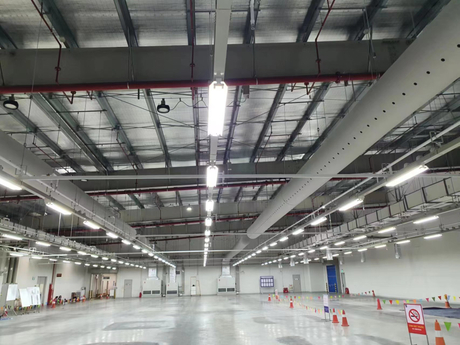
The core pain point in factory construction is the conflict between "rigid systems" and "flexible demands." Metal duct designs are based on a fixed process layout at a specific moment. Once equipment is moved or workstations are added, the original air supply points become obsolete. Adding new ducts is often constrained by existing structures, forcing compromises. Fabric ducts overcome this through a sliding rail quick-release system and variable permeability modules, achieving a "Lego-like" reconfiguration of the ventilation system. Duct sections are connected via zippers for rapid detachment, and the suspension system uses industrial aluminum rails, allowing positions to be adjusted along the track without tools.
This flexible adaptation value is particularly prominent in three scenarios:
Flexible Manufacturing Workshops: An automotive parts factory utilizing "cellular manufacturing" adjusts its equipment layout quarterly. Using fabric ducts with movable rails, two workers can complete the duct reconfiguration in just half a day. In contrast, modifying a metal duct system of equivalent scale would require a week-long shutdown and multiple specialized welders.
Cleanroom Expansion: During the expansion of electronics plants, fabric ducts can be extended like "building blocks" without breaking the original ceiling seal. This perfectly accommodates the strict requirements of "non-stop production modifications" in cleanrooms.
Warehouse Logistics Sorting Lines: E-commerce warehouses typically expand their sorting lines before major shopping festivals. Fabric ducts support the rapid addition or removal of air supply modules, ensuring new workstations receive the same airflow and preventing efficiency drops caused by localized overheating.
It is important to note that factory-specific fabric ducts must pass anti-static and abrasion resistance tests to ensure stable performance during frequent disassembly and reassembly. As "lights-out factories" and "flexible manufacturing" become mainstream, fiber fabric ducts are evolving from fixed installations into "living systems" that adapt on demand. They inject unprecedented agility into factory construction through a modular mindset.

NO999, Sunqiao RD, Pudong area, Shanghai, China

+86 138 1637 7866