Views: 0 Author: Site Editor Publish Time: 2026-08-10 Origin: Site
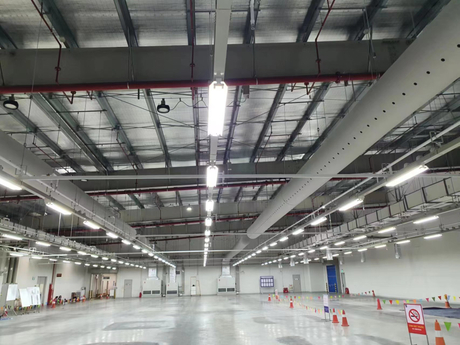
In high-end manufacturing facilities, temperature uniformity is a critical determinant of product yield. Traditional metal ducts often fall into the "near-cold, far-hot" trap: cold air pools near the outlets while distant equipment bakes in heat waves. This thermal stratification is particularly detrimental in electronics and new energy plants where ceiling heights exceed 8 meters and equipment heat density is high. Fiber Fabric Ducts are emerging as the "Airflow Actuaries" of factory construction, utilizing data-driven precision to rebalance thermal environments.
The core conflict in complex industrial thermal environments is the mismatch between "dispersed heat sources" and "lagging airflow." Metal ducts, limited by fixed vents, struggle to respond to real-time fluctuations in production line heat output. Fabric ducts overcome this through CFD (Computational Fluid Dynamics) simulation coupled with variable permeability design, upgrading air supply logic from "guesswork" to "algorithm-driven" precision. During the design phase, engineers map the heat generation profile of the equipment and strategically place micro-perforations of varying diameters along the duct wall—increasing porosity in high-heat zones and reducing it where cooling demand is lower. This "on-demand" distribution model keeps cross-sectional temperature differences within ±1.5°C.
This actuarial value is particularly evident in three high-tech scenarios:
Lithium-Ion Battery Dry Rooms: Electrode sheet baking processes are extremely sensitive to temperature fluctuations. Fabric ducts eliminate localized eddies through uniform surface-air delivery, ensuring the temperature difference between any two points in the room stays within ±1°C, significantly improving cell consistency.
SMT (Surface Mount Technology) Assembly Lines: Precision placement machines demand strict airflow stability. Fabric ducts provide low-velocity (0.2–0.5 m/s) permeable air supply, avoiding disturbances to sensitive components while maintaining a positive pressure of +15 Pa to effectively block external dust ingress.
Data Center Server Rooms: Server racks generate "hot spots." Fabric ducts can be tailored to enhance air supply directly above these heat sources. When combined with closed cold-aisle containment, this can improve the Cooling Performance Coefficient (COP) by over 15%.
It is important to note that factory-specific fabric ducts must pass B1-level flame retardancy and anti-static certifications to ensure operational safety in complex electromagnetic environments. As Industry 4.0 advances the need for meticulous production environment control, fiber fabric ducts are evolving from simple ventilation equipment into the "nerve endings" of thermal management—safeguarding every degree of temperature in high-end manufacturing with millimeter-level air supply accuracy.

NO999, Sunqiao RD, Pudong area, Shanghai, China

+86 138 1637 7866