


Views: 2 Author: Site Editor Publish Time: 2026-11-20 Origin: Site
In textile and garment plants the difficult part of air conditioning is rarely temperature. It is dust and humidity. Circular knitting machines and looms throw off fly and short fibres continuously, and sewing stations produce fabric dust. Once these fibrous particles are drawn into air outlets, diffuser blades and galvanised duct walls collect a mat of lint, supply air volume decays year after year, and cleaning means stopping production and erecting scaffolding. At the same time, yarn strength and static charge are directly linked to relative humidity, so air that surges or blows directly onto the machines raises the breakage rate.
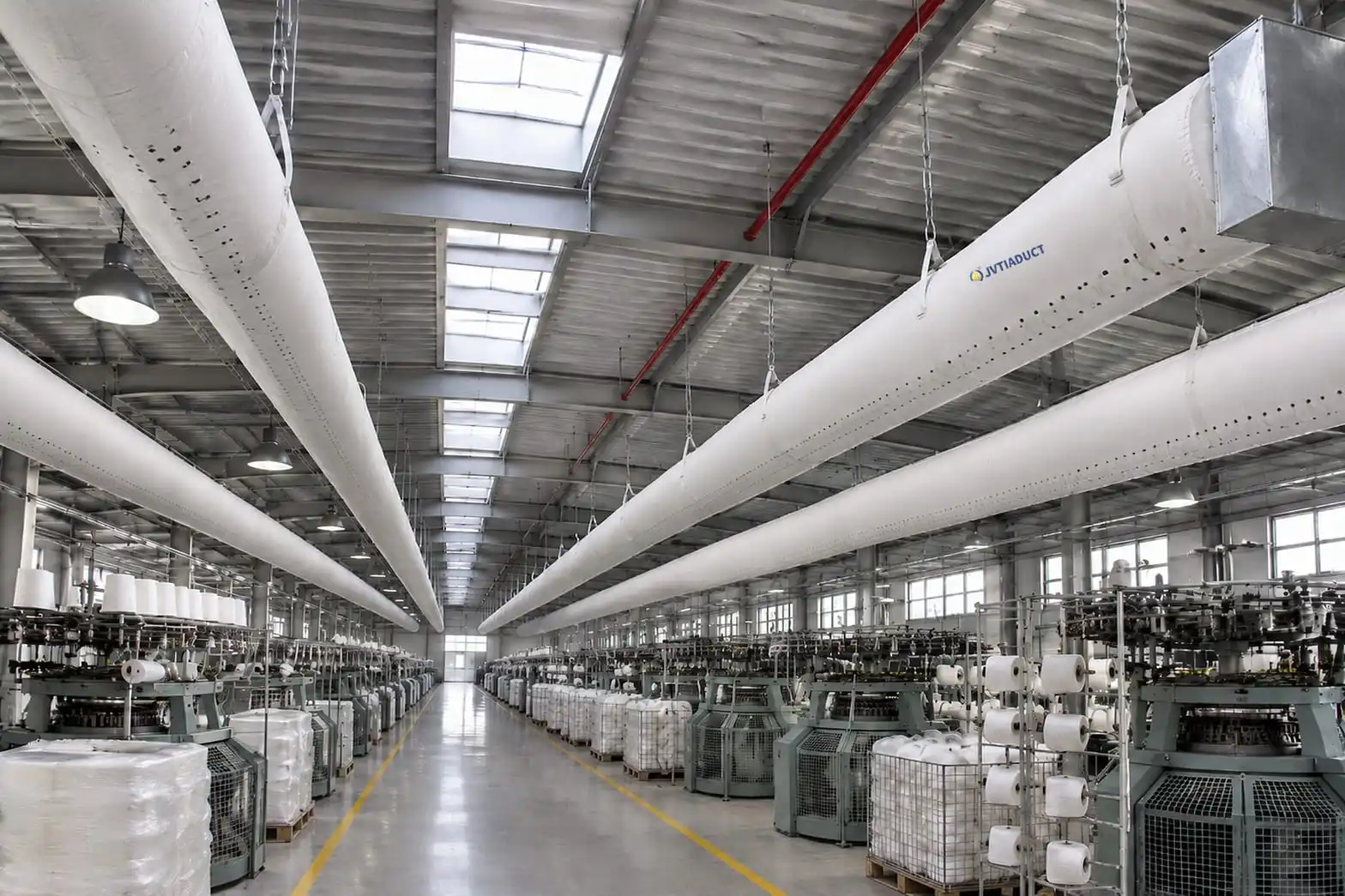
Illustrative image: JVTIADUCT fabric duct system in a textile mill.
1. Lint build-up and cleaning
When a metal duct or a diffuser collects lint, it has to be opened up and washed, yet textile plants usually run continuously and have very short shutdown windows. A fabric duct can be taken down in sections and machine-washed, the lint rinses away, and the system returns to its design resistance once it is re-hung. In weaving areas with high dust loading this matters a great deal. In practice the penalty of a linted system shows up long before anyone climbs up to inspect it: fan speed creeps up to hold the room, and some aisles stay warm while others are cold.
2. Low velocity that leaves yarn and fabric alone
Fabric ducts deliver air through micro-perforations along their length, so the discharge momentum is low and the distribution is even. Air movement between machines stays gentle: it does not deflect yarn, lift fabric or create turbulence near the knitting point, which makes it a better fit than high-velocity spot diffusers in densely packed workshops. Because the outlets are spread along the full length of the run instead of being concentrated at a few points, conditioned air reaches the aisles between the machines rather than being dumped near the roof.
3. Even humidity and static control
Textile halls need high, stable humidity. Because the duct runs the whole length of the shed, supply air is distributed fairly evenly along that length, which narrows the gap between an over-cooled near end and a starved far end. Combined with a humidification system, this supports stable yarn regain and safe static dissipation.
4. Fire performance and maintenance
Textile plants carry heavy combustible loads, so duct materials have to meet fire requirements. JT-N non-combustible fabric can be specified, or JT-H ventilation type and JT-P purification type according to the duty. The products meet EN 13501-1, EN 13823 and UL 723 and carry CE marking. Routine maintenance is mainly checking cable tension, seam condition and the webbing at each hanger. The duct itself is light, so replacing a damaged section does not call for heavy lifting gear and can usually be fitted into a normal maintenance window.

NO999, Sunqiao RD, Pudong area, Shanghai, China

+86 138 1637 7866


