


Views: 1 Author: Site Editor Publish Time: 2026-11-16 Origin: Site
Theaters, concert halls, and grand auditoriums represent some of the most acoustically demanding spaces in modern architecture. These facilities typically feature high ceilings, tiered spectator seating, and extensive lighting and acoustic baffles suspended overhead. When conventional rigid sheet metal ductwork and concentrated diffusers are deployed in such spaces, high-velocity air currents frequently produce audible whistling at air registers, while rigid duct walls tend to vibrate in resonance with fan frequencies. Furthermore, because patrons remain seated quietly for extended hours, direct cold drafts can severely compromise viewing comfort. Consequently, flexible fabric air dispersion systems—commonly known as fabric ducts or textile ducts—have gained widespread adoption in performing arts venues and auditoriums.
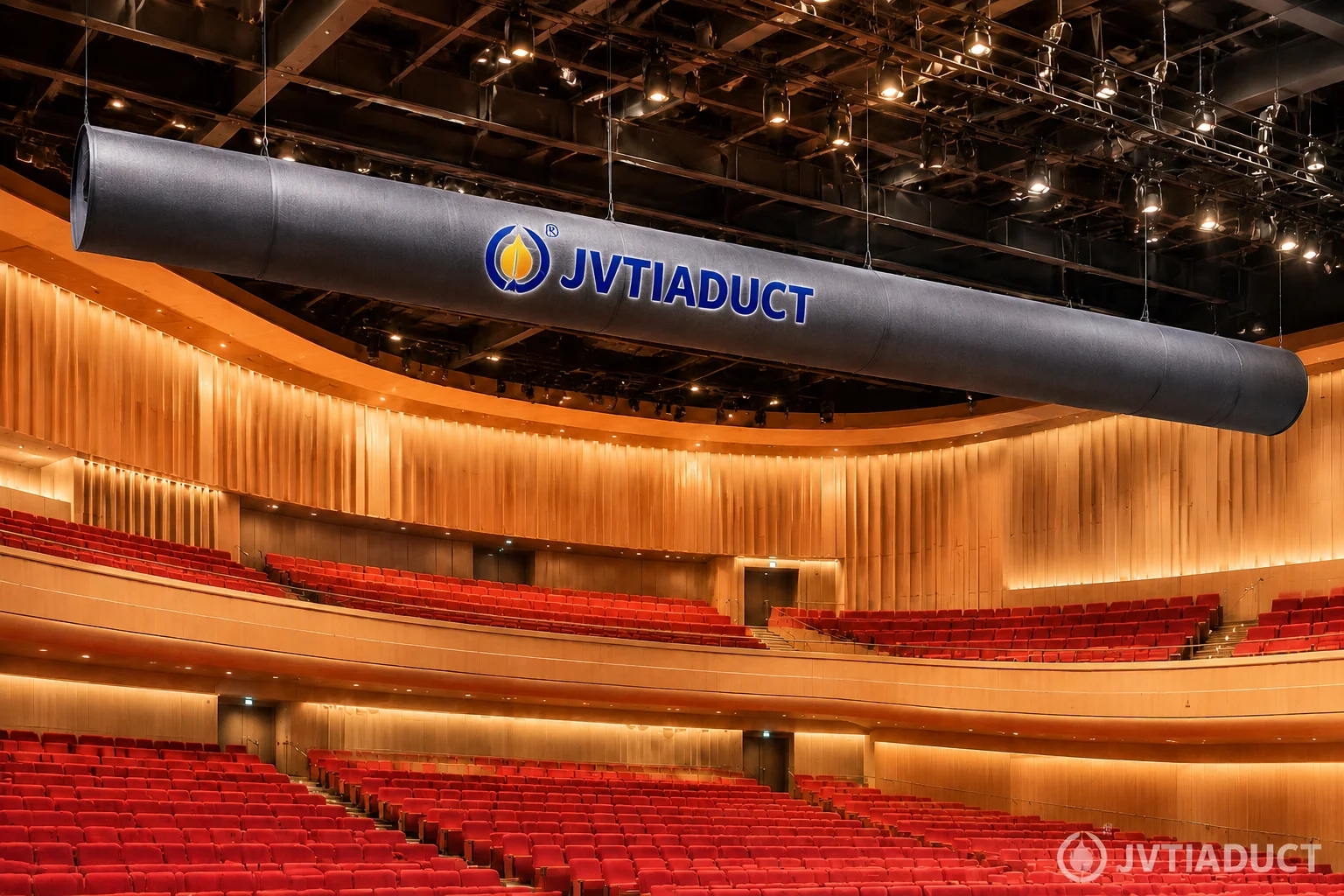
Illustrative image: JVTIADUCT fabric duct system in a theater auditorium.
1. Strict Acoustic Demands: Eliminating Metallic Noise at the Source
Grand theaters and concert auditoriums generally enforce stringent background noise criteria, typically below NC-25 or NC-30. Flexible textile air ducts constructed from engineered technical fibers possess inherent acoustic damping characteristics. Unlike rigid sheet steel, the permeable fabric body absorbs vibration rather than amplifying it. As conditioned air equalizes within the duct chamber and diffuses through micro-perforations, it eliminates the turbulent jet roar associated with metallic registers, thereby safeguarding acoustic clarity across the auditorium.
2. Low-Velocity Displacement: Banishing Drafts in Tiered Seating
Auditorium seating slopes upward along stepped terraces, creating vertical thermal gradients where warm air accumulates beneath the high ceiling while cold air pools unevenly at lower levels. Fabric duct systems address this imbalance by distributing airflow continuously along the entire length of the hall through laser-cut micro-apertures. The dynamic supply pressure converts smoothly into static pressure, ensuring gentle, low-velocity displacement ventilation. Air velocities in the occupied zone remain uniformly low, providing a stable thermal envelope without noticeable draft sensation.
3. High-Ceiling Lightweight Routing and Fire-Resistant Selection
Ceiling spaces in performing arts facilities are heavily crowded with stage lighting rigs, motorized scenery winches, and acoustic reflector panels, leaving little structural load margin. Fabric ductwork weighs approximately one-tenth of traditional spiral steel ducting, requiring only lightweight aircraft cables for suspension and substantially alleviating dead loads on roof trusses. For high-occupancy assembly venues, technical fabrics such as the JT-N non-combustible series are selected to meet international fire standards, including EN 13501-1, EN 13823, and UL 723, accompanied by CE conformity certification.
4. Lifecycle Washability and Simple Structural Maintenance
Because auditoriums remain largely enclosed throughout the year, internal contamination within concealed metal ductwork poses challenging sanitation and dust-removal problems. Textile duct systems utilize modular industrial zipper joints that permit rapid disassembly. Sections can be taken down, laundered, sanitized, and remounted without specialized tooling. This washable lifecycle prevents particulate build-up and maintains fresh, odorless air quality throughout decades of continuous venue operation.

NO999, Sunqiao RD, Pudong area, Shanghai, China

+86 138 1637 7866


