


Views: 0 Author: Site Editor Publish Time: 2026-10-19 Origin: Site
Air in a food plant is not only a comfort question. Production areas are typically split into general and high-care zones, and equipment surfaces, ceilings and air outlets all fall inside the hygiene audit. If an air system produces condensation drips, dust-collecting dead corners or assemblies that cannot be taken down for washing, the consequence is not discomfort — it reaches the product and the batch. That is why textile air distribution has been gaining ground in food manufacturing.
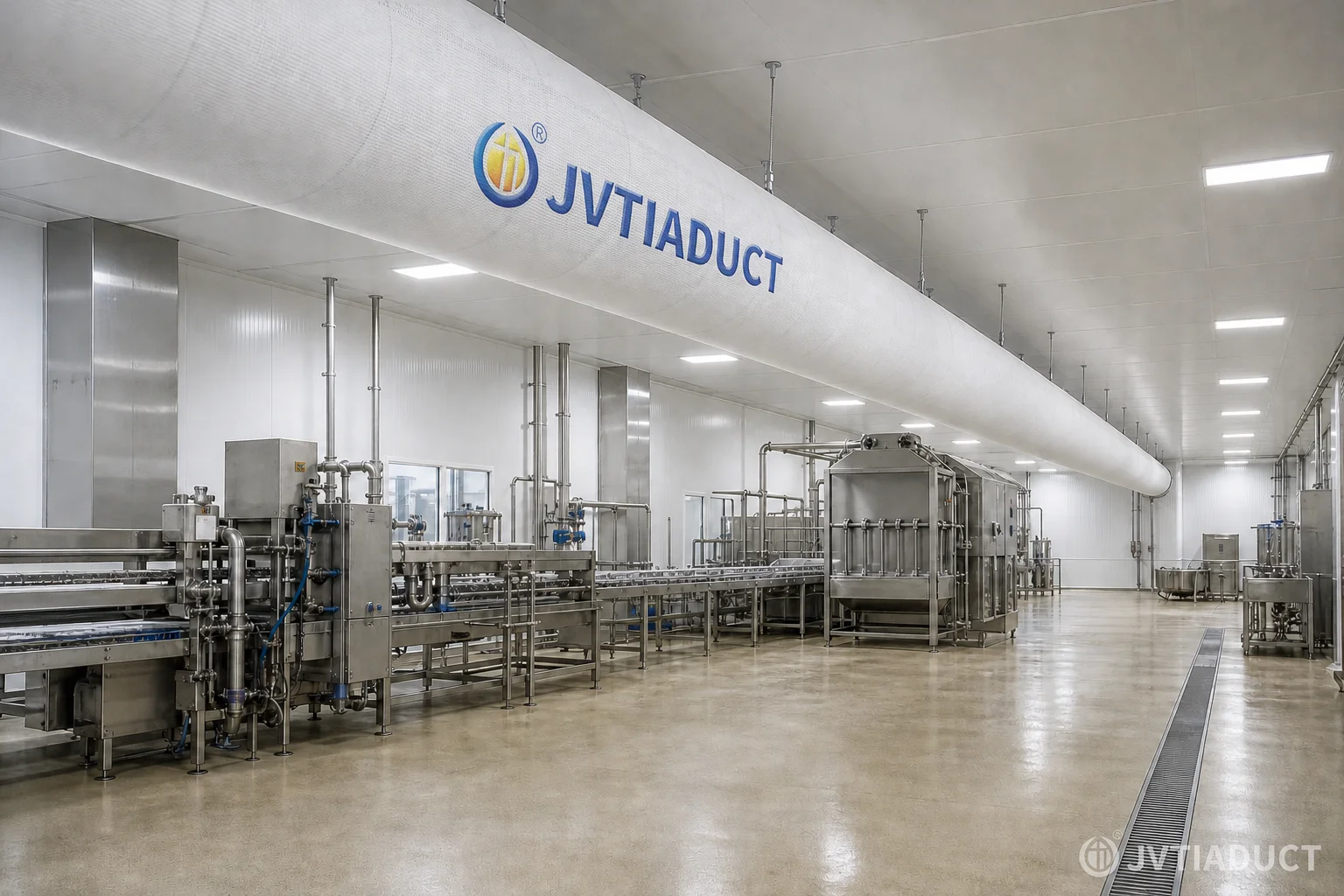
Illustrative image: JVTIADUCT fabric duct system in a food processing plant.
Three hard requirements in a food plant
Filling, cooling, fermentation and baking are sensitive to swings in temperature and humidity; a local cold spot or a hot pocket can destabilise the process. Low-temperature supply air meeting a humid room is the classic condensation risk, and a drip from a metal duct is the last thing a food plant wants to see. And because rooms are washed and disinfected on a schedule, a duct that cannot be removed or reached becomes a hygiene dead corner.
How a fabric duct answers them
A fibre fabric duct is a lightweight textile air dispersion system suspended under the ceiling. The duct wall is permeable, or fitted with engineered outlets along its length, so air is introduced at low velocity over a large surface instead of through a few concentrated diffusers. The result is a more even distribution and no strong local draught. Because air passes continuously through the permeable wall, the duct surface stays close to the supply air temperature, which markedly reduces the risk of surface condensation. The duct is light and can be designed for removal, so cleaning does not require dismantling large areas of ceiling, and there are no metal joints or corrosion points to collect dust.
Selecting by zone
JT-H suits general ventilation in ambient production areas; JT-P is intended for filling and packing areas with cleanliness requirements; JT-T, the insulated composite type, is the choice for low-temperature or high-humidity zones with condensation risk; JT-N meets non-combustible requirements where the building specification demands it. Fire performance of the duct material can be checked item by item against EN 13501-1, EN 13823, UL 723 and CE documentation, so the material can be matched to a project’s acceptance criteria.
Bringing air supply in early
Most rework in food plants comes from late decisions: a duct route that clashes with process pipework, an outlet that ends up too close to an operating position, a cleaning route that never aligned with the ceiling access panels. Bringing the dispersion system into the design at concept stage lets the route, outlet type and service access be fixed while changes are still cheap.
For a food processing plant the test of a good air system is simple: stable temperature, a dry surface, and a duct you can take down and wash.

NO999, Sunqiao RD, Pudong area, Shanghai, China

+86 138 1637 7866


