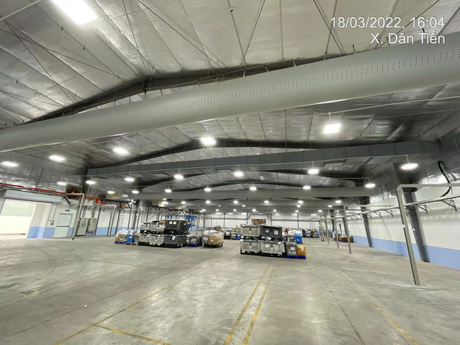
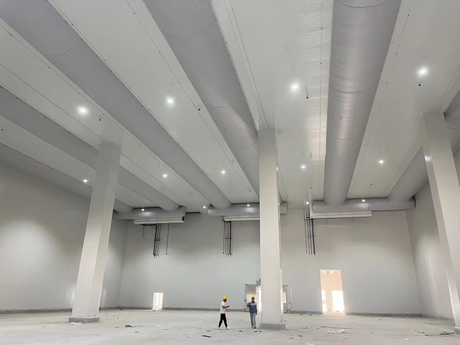
In conventional engineering, ventilation systems are typically treated as two separate modules: the "air handler" and the "ductwork." In real-world operation, however, Fiber Fabric Ducts are bridging this divide. They are far more than mere transit channels; they function as active air equalization regulators connecting the unit to the occupied space.
Traditional metal ducts suffer from internal friction and static pressure loss, frequently causing "strong proximal flow, weak distal attenuation." To compensate for insufficient terminal airflow, the HVAC unit must ramp up to higher power. Fiber fabric ducts address this with variable permeability design. By precisely adjusting fabric porosity and orifice density along the duct length—in response to static pressure changes—they achieve remarkably consistent outflow across the entire system. This "active equalization" effectively reduces the burden on the main unit. Under equivalent cooling loads, fan frequency can be lowered by 15%–20%, delivering genuine system-level energy savings.
This value becomes even more pronounced in architecturally complex spaces. Faced with domed ceilings, sloping roofs, or irregular steel frameworks, metal ducts require numerous custom fittings, leading to higher leakage rates and unpredictable airflow patterns. Flexible fabric ducts, by contrast, conform seamlessly to structural contours. When paired with CFD airflow simulation to pre-validate velocity and temperature fields under various conditions, designers can lock in performance accuracy before installation begins.
Furthermore, the lifecycle cost advantage is often underestimated. While initial investment may slightly exceed that of standard metal ducts, a comprehensive assessment—factoring in shorter installation times, reduced support structures, and zero ongoing insulation maintenance—reveals that total cost of ownership typically falls below traditional systems within five years.
Fiber fabric ducts are reshaping how we understand ventilation. They are not isolated components, but intelligent terminals working in concert with the air handler. When engineers integrate them into early-stage design, the result is often a level of comfort and cost-efficiency that exceeds all expectations.