Views: 2 Author: Site Editor Publish Time: 2026-04-27 Origin: Site
In the realm of HVAC and industrial ventilation, few technologies have managed to shatter stereotypes as effectively as fabric ducting (commonly known as textile ducts or "Sox" systems).
There was a time when mentioning fabric in the context of ventilation would cause project managers and fire safety inspectors to furrow their brows. In buildings filled with electrical panels, heavy machinery, and high-power heating units, hanging rows of fabric tubes seemed like a reckless gamble with fire codes. The fear was palpable: would these tubes act as fuses in a fire, or worse, serve as fuel for the flames?
Times have changed. Modern building codes haven't just accepted fabric ducts; they have embraced them in stadiums, cold chain logistics centers, food processing plants, and even high-tech cleanrooms. The magic behind this acceptance lies in a deceptively technical field: material flame retardancy and fireproofing technology.
Today, we dive deep into how these seemingly harmless "fabric bags" meet the most stringent fire safety standards, transforming from potential fire hazards into certified safety assets.
The most effective way to handle fire safety is not to fight fires after they start, but to ensure the material fundamentally "hates" burning. It’s about selecting the right raw material from the very beginning.
Premium fabric ducts no longer rely on standard polyester or nylon. These conventional synthetic fibers burn aggressively, drip molten plastic, and release toxic fumes—a nightmare scenario in any fire.
To eliminate these risks, leading manufacturers utilize inherently flame-retardant fibers. This isn't about slapping a coating of chemicals onto the fabric after weaving. Instead, it involves chemical "genetic engineering"—modifying the polymer structure during the polymerization phase or introducing grafted flame-retardant monomers. Elements like phosphorus and nitrogen are integrated directly into the molecular backbone.
This intrinsic property gives the material a self-sacrificing mechanism. When exposed to extreme heat or direct flame, these hidden elements activate, rapidly capturing highly active free radicals (effectively cutting the communication lines of the fire's spread) and promoting carbonization on the fiber surface. This char layer acts as a shield, perfectly isolating oxygen and leaving the flames frustrated. Crucially, this permanent modification ensures the fire resistance lasts. Even after 15 years of service or over 50 wash cycles, the fire performance remains intact, avoiding the尴尬 situation where sprayed-on coatings wash off.
If modified fibers are the internal Kung Fu, functional coatings are the impenetrable external armor.
For high-stakes applications, fiber modification alone isn't enough. Engineers employ coating technologies to add extra layers of protection. Through precise dipping and padding processes, flame retardants, water repellents, and antimicrobial agents are combined into a multi-dimensional defense network.
A standout innovation is nano-composite coating technology. Imagine nano-scale flame-retardant particles (like modified aluminum hydroxide or nanoclays) uniformly dispersed within the polymer coating. Upon exposure to fire, these particles trigger the formation of a dense, ceramic-like char layer. This layer provides exceptional thermal insulation, protecting the internal fiber skeleton, and significantly reduces smoke generation.
In extreme environments, manufacturers may opt for silicone or fluorosilicone coatings. These not only maximize fire ratings but also solve issues related to moisture, acid corrosion, and aging, truly achieving multi-functional protection.
In construction, claims are meaningless without passing rigorous standardized tests. Regardless of marketing hype, a product’s ability to enter the market depends on surviving "torture tests" defined by international standards.
In China, fabric ducts must strictly comply with the GB 8624-2012 Classification for Burning Behavior of Building Materials and Products. Most public buildings require at least a B1 rating (difficult-to-burn materials), while high-risk areas demand A2 grade inorganic composites (such as aerogel-infused insulation).
What do these letters and numbers actually mean?
Take the common B1 classification: B-s1, d0, t0. It’s a micro-survival guide:
B: Limits the Fire Growth Rate Index (FIGRA) to below 120 W/s and Total Heat Release (THR600s) to under 7.5 MJ. Simply put, even if ignited, the heat release is so slow it buys precious time for evacuation.
s1: Signifies low smoke production. Since most fire fatalities result from smoke inhalation, this rating ensures visibility remains high during a blaze.
d0: Indicates no burning droplets. This prevents secondary fires caused by falling embers.
t0/t1: Certifies low toxicity, ensuring no lethal gases are released during combustion.
A qualified duct must burn "reluctantly," "cleanly," and "non-toxically."
Understanding these hardcore technologies explains why fabric ducting is gaining market share. Traditional galvanized steel ducts, while non-combustible, are heavy (over 10 kg/m²), requiring massive support structures. They are also prone to condensation and require bulky external insulation.
In contrast, fabric ducts weigh less than 1 kg/m². Their flexibility allows them to navigate complex architectural obstacles gracefully. Installation is quick, requiring only a suspension system and a few workers, drastically reducing labor costs and project timelines.
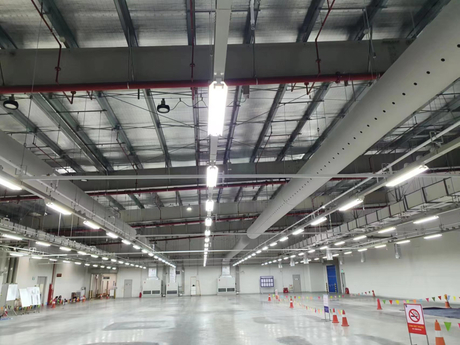
Most importantly, thanks to advanced fiber and coating tech, they have shed the "flammable" label. They suppress smoke and fire spread while providing superior air distribution through micro-perforations, eliminating hot spots and cold drafts.
The "fireproofing technology" of fabric ducts might seem like a niche topic, but it represents the convergence of polymer chemistry, nanotechnology, and fluid dynamics.
In an era demanding efficiency, safety, and comfort, no material rises by luck alone. From a questionable "fabric bag" to a high-tech air distribution system competing with steel, fabric ducting has carved out its place through relentless innovation in fire safety.
So, next time you look up in a warehouse or stadium and see those lightweight fabric tubes, remember: beneath that soft exterior flows the hardcore blood of fire-resistant science.

NO999, Sunqiao RD, Pudong area, Shanghai, China

+86 138 1637 7866