


Views: 2 Author: Site Editor Publish Time: 2025-12-31 Origin: Site
Fabric air ducts (also known as textile ducts, fiber fabric ducts, or fabric-based air distribution systems) are flexible air supply ducts made from specialized polymer fiber materials. They are widely used in applications demanding high standards of airflow organization, hygiene, and noise control—such as food processing facilities, electronic cleanrooms, sports arenas, and commercial spaces. Compared with traditional metal ducts, fabric ducts offer significant advantages including lightweight construction, ease of installation, no condensation, uniform airflow distribution, and washability. However, their design calculation methods differ substantially from those of conventional ducts and require comprehensive consideration of material properties, permeability, air delivery methods, and other factors.
This article systematically presents the design calculation procedure for fabric air ducts, covering key steps such as airflow determination, duct diameter selection, pressure loss calculation, layout of air outlets/slots, and static pressure control.
The required total supply airflow is determined based on cooling load calculations:
Where:
Qcooling: Room cooling load (W)
cp: Specific heat capacity of air (≈1005 J/(kg·K))
ρ: Air density (≈1.2 kg/m³)
ΔT: Supply–return air temperature difference (K)
The result is typically converted to m³/h.
Common air delivery configurations for fabric ducts include:
Perforated/permeable diffusion: Air uniformly diffuses through micro-pores in the fabric
Linear slot diffusion: Continuous slots along the duct length
Nozzle/jet diffusion: Circular or rectangular nozzles installed at intervals
Hybrid diffusion: Combination of multiple methods
The chosen delivery method directly affects static pressure distribution and velocity decay, and must be finalized early in the design process.
Air velocity inside fabric ducts is typically maintained between 6–10 m/s in main sections (or lower near terminals) to minimize noise and ensure uniform static pressure.
The initial duct diameter can be estimated using:
Where:
D: Internal duct diameter (m)
Q: Airflow rate (m³/h)
v: Design air velocity (m/s)
Since airflow continuously decreases along the duct due to distributed delivery, tapered (variable-diameter) designs or segmented constant-diameter sections with terminal closure are commonly employed.
Pressure loss in fabric ducts consists primarily of two components:
Although fabric surface roughness differs from metal, the Darcy–Weisbach equation can be used as an approximation:
Where:
λ: Friction factor (typically 0.02–0.04 for fabric ducts; exact value provided by manufacturer)
L: Length of duct segment (m)
D: Equivalent diameter (m)
Note: Due to decreasing airflow along the duct, calculations should be performed segment-by-segment or simplified using average airflow methods.
Includes losses from bends, reducers, and tees. However, thanks to the flexibility of fabric ducts, bend resistance is significantly lower than in metal ducts and is often negligible or conservatively estimated (e.g., ≈10–20 Pa per 90° bend).
As air is continuously discharged along the duct, dynamic pressure is converted into static pressure—a phenomenon known as static pressure recovery. Proper design leverages this effect to achieve nearly uniform static pressure throughout the duct, which is one of its core advantages.
For permeable fabrics, the specific airflow per unit area qs (m³/(h·m²)) relates to static pressure Ps (Pa) as follows (typically provided by the manufacturer):
Where:
k: Permeability coefficient (material-dependent)
n: Exponent (usually 0.5–0.7)
For slotted or nozzle-based systems, opening area and quantity are determined based on required airflow and throw distance. A common formula is:
Where:
Qi: Airflow at outlet i (m³/s)
Cd: Discharge coefficient (typically 0.6–0.8)
Ai: Opening area (m²)
Ps,i: Local static pressure (Pa)
To ensure uniform air distribution, static pressure variation along the duct must be minimized. Strategies include:
Variable-permeability fabric: Low permeability at the inlet end, high permeability toward the outlet
Variable opening density: Increase nozzle count or slot width in downstream sections
Integrated pressure-stabilizing layer: High-end products use dual-layer construction to maintain uniform pressure
Ideally, static pressure fluctuation along the entire duct should be kept within ±10%.
Where:
ΔPtotal: Pressure loss in connecting ductwork (metal or flexible) from fan outlet to fabric duct inlet
Pterminal static: Minimum static pressure required at the duct terminal to sustain airflow (typically 50–150 Pa, depending on delivery method)
Is air velocity within allowable limits? (to avoid vibration or noise)
Is airflow distribution uniform? (validated via CFD simulation or empirical formulas)
Is condensation risk eliminated? (duct surface temperature > dew point)
Are suspension tension and hanger spacing appropriate? (typically 1.5–3 m)
A spectator area in a gymnasium requires 12,000 m³/h of supply air using a linear-slot fabric duct, 30 m in length.
Initial velocity selected: 8 m/s → calculated diameter ≈ 730 mm → standard size DN700 adopted
Divided into 5 segments, each delivering 2,400 m³/h (airflow decreases progressively)
Manufacturer data indicates required static pressure ≈ 80 Pa
Friction loss calculated (using segment-average velocity method): ΔP_f ≈ 35 Pa
Required fan total pressure ≥ 80 + 35 + connector loss ≈ 130 Pa
Slot width increased in downstream sections to compensate for static pressure drop and ensure uniform delivery
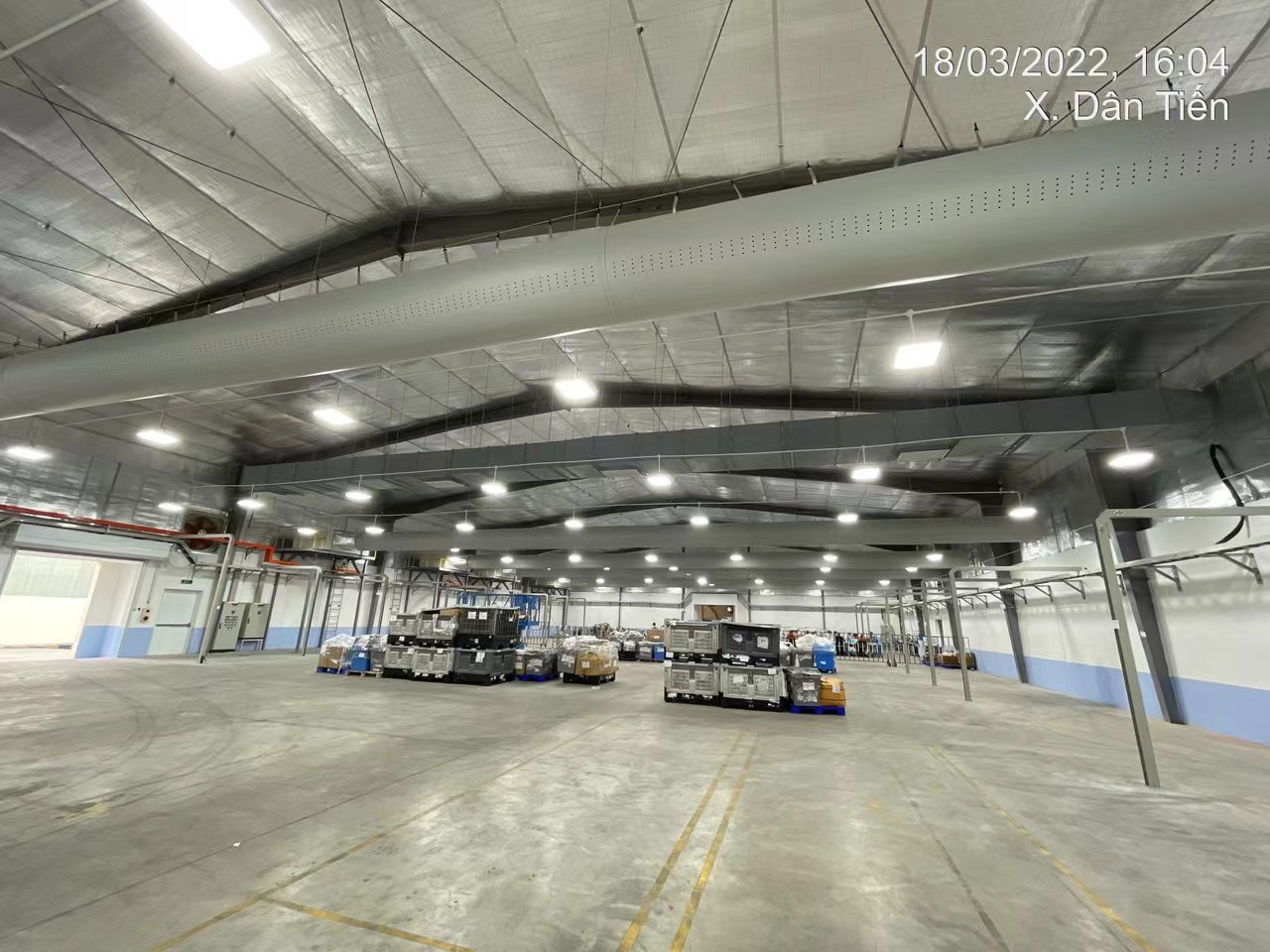
Although fabric duct design calculations are grounded in classical fluid dynamics principles, they must fully account for unique characteristics such as flexibility, permeability, and static pressure recovery. Accurate design relies heavily on material performance data provided by manufacturers—including permeability coefficients, friction factors, and maximum operating pressure—and is best complemented by CFD simulation for airflow optimization. With advances in smart manufacturing and new materials, fabric air ducts hold great promise in energy-efficient and healthy building applications, and their design methodologies will continue to evolve and improve.

NO999, Sunqiao RD, Pudong area, Shanghai, China

+86 138 1637 7866


