

Views: 1 Author: Site Editor Publish Time: 2026-10-28 Origin: Site
A library reading room is judged by what visitors do not notice: the air. In most reading halls the working target is roughly 40-50 dB(A) of background noise, and a diffuser that whistles at 35 dB(A) beside a desk will be heard. The stacks add a slower constraint. Paper wants a stable relative humidity in the 45-55% band, and a cold metal duct surface in a humid summer is exactly where condensation, drip marks and mould begin.

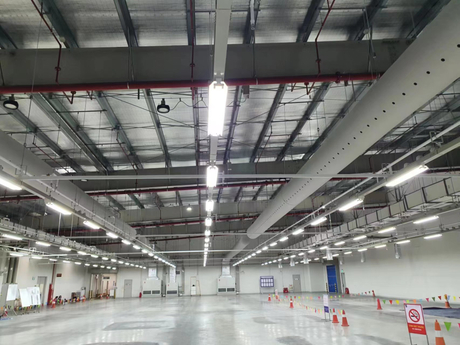
Illustrative image: JVTIADUCT fabric duct system in a library reading room.
Three hard requirements
Quiet comes first: air velocity at the occupied zone should stay below 0.15-0.2 m/s in reading areas so pages do not flutter and readers do not feel a draught on the neck. Second, the supply must be spread over a long throw without concentrated jets, because a reading room is deep and low, and a single grille cannot cover 15 metres of table without doubling its velocity. Third, humidity inside the duct must not create surface condensation: any duct running above the stacks has to stay at or above the dew point of the room air, or it will drip onto the collection.
How a fabric duct answers them
A fabric duct is a large-diameter, low-velocity plenum made of woven or coated permeable fabric. Because the cross-section is big and the surface is porous, supply air leaves along the whole length at 1-3 m/s at the surface, so the terminal velocity reaching a reader two metres below is far lower than at a metal diffuser carrying the same airflow. The fabric surface also absorbs a useful part of the higher-frequency noise and, with no rigid terminal boxes or volume dampers at the outlets, the duct itself generates almost no aerodynamic noise. On humidity, the permeable fabric does not create a cold metal skin: air migrates slowly through the weave and the surface stays closer to room temperature, which is why fabric ducts are commonly used where dripping is unacceptable.
Selecting by zone
Reading areas and stacks should not be served by the same outlet pattern. Over tables, a permeable fabric with a diffuse, directional-free discharge is the usual choice, sized for 0.1-0.15 m/s at head height. Over compact shelving and archive stacks, the priority shifts to gentle, uniform movement with no direct impingement on the books: a low-perforation or laser-perforated fabric, or a half-permeable variant with the permeable face turned to the aisle, keeps air moving without drying one shelf line faster than the next. Circulation desks, cloakrooms and staff areas can take a higher velocity and a shorter run. Where a room is refurbished and the ceiling void is shallow, a flat-oval or half-round section allows the same airflow in less depth.
Fixing position early
The duct layout has to be settled before the ceiling and lighting grid are fixed, because the fabric duct needs a clear, unobstructed run and a suspension line that does not fight the light fittings. Two practical points: keep at least 0.5-1 m between the duct and any sprinkler head or detector so the air pattern does not interfere with them, and leave the tensioning and zipper access at a point that a librarian, not a scaffolder, can reach. Because most fabric systems are delivered as factory-made sections with the outlet pattern already cut, a late change of the outlet orientation means a new section, not an adjustment on site. Confirm the suspension height, the inlet connection and the orientation of the permeable face at the drawing stage, and the installation itself is a short, clean operation with no painting or duct insulation afterwards.
For a library, the value of a fabric duct is not that it is quiet in isolation, but that quiet, draught-free supply and a condensation-free surface come from the same component. Choose the fabric and the outlet pattern per zone, fix the geometry before the ceiling closes in, and the reading room stays silent while the stacks stay stable.

NO999, Sunqiao RD, Pudong area, Shanghai, China

+86 138 1637 7866